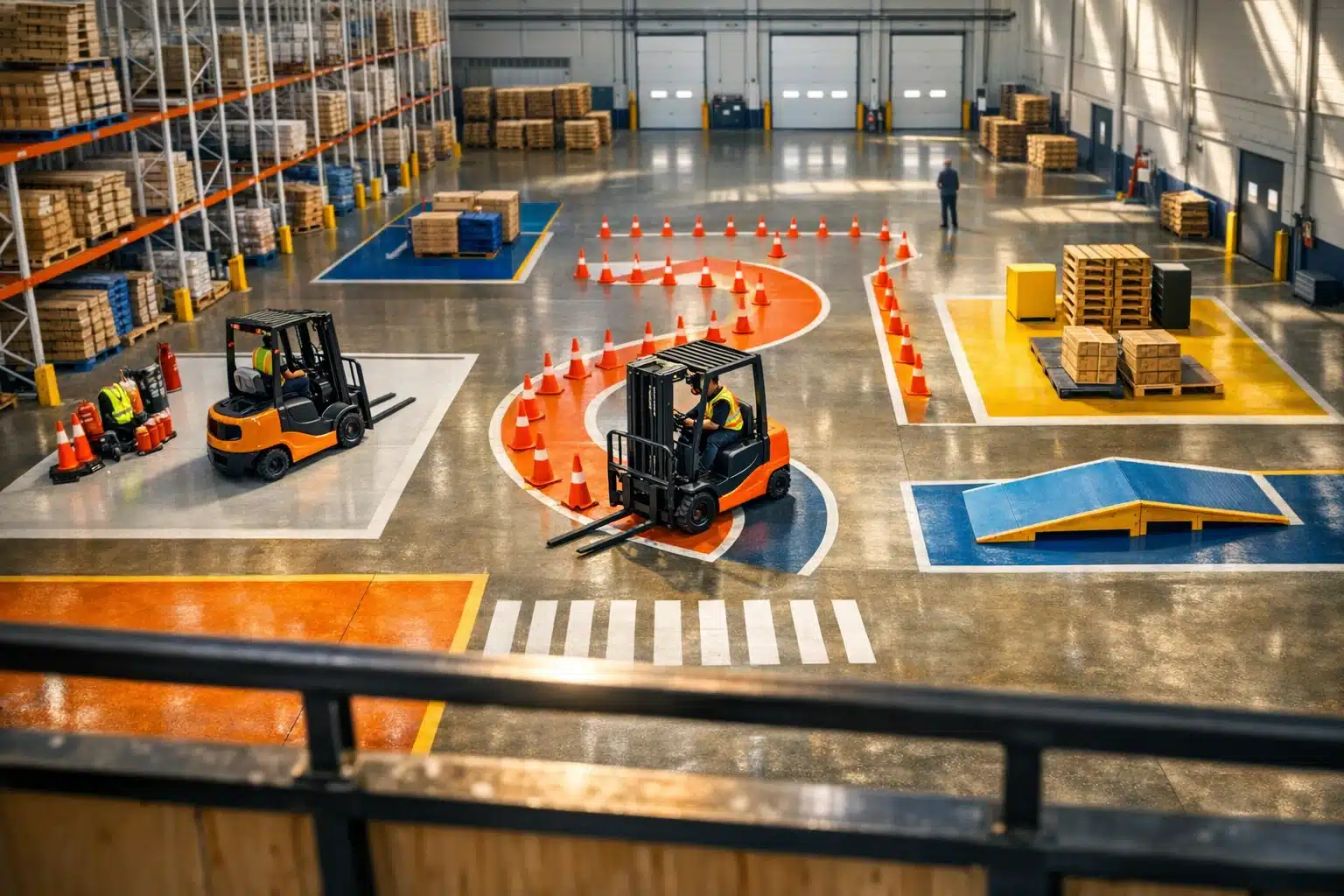
 Artificially generated image
 Top 5-Day Forklift Certification Courses
Forklift certification often sounds like a box to tick, but the training behind it can shape safety, confidence, and employability in a very direct way. A five-day course gives beginners enough room to absorb regulations, learn equipment basics, practice careful handling, and prepare for an operator evaluation without rushing every lesson. For job seekers, warehouse staff, and employers, understanding that weekly structure helps turn a vague requirement into a practical plan.
This guide follows a simple outline: why the five-day format matters, what the daily schedule usually covers, how costs and documents are handled, how to compare providers, and what the full journey looks like from enrollment to completion.
Why a Five-Day Forklift Course Matters and What This Article Covers
Not every forklift program lasts five days, but that schedule is common because it gives learners time to build skills in layers instead of trying to absorb everything in one exhausting burst. A beginner usually needs more than a quick slideshow and a short quiz. Safe forklift use depends on judgment, visibility, load balance, speed control, pedestrian awareness, and machine familiarity. Those habits are easier to build when instruction is spread over several days, with room for questions, demonstrations, and correction.
Explore 5-day forklift training courses, including safety topics, practical instruction, operator evaluation and certification requirements.
That sentence captures the heart of the topic, but the details matter. In the United States, forklift training is shaped by OSHA rules, especially 29 CFR 1910.178(l), which requires three elements: formal instruction, practical training, and an evaluation of operator performance. In other words, a certificate should never be treated as a magic card earned by attendance alone. A strong course teaches the principles, demonstrates the equipment, allows supervised practice, and checks whether the trainee can operate safely. Many employers also add site-specific instruction because warehouse aisles, loading docks, ramps, trailers, and pedestrian traffic create hazards that vary from one workplace to another.
A five-day format is especially useful for:
• first-time operators
• workers changing industries, such as moving from retail stockrooms to large distribution centers
• employers onboarding a group with mixed experience
• job seekers who want a structured pace instead of a compressed refresher
This article is organized to help those audiences make sense of the process before spending time or money. It looks at what a realistic weekly schedule often includes, why some courses cost more than others, what paperwork you may need, and who usually pays. It also explains how to choose a provider with substance rather than shiny marketing. Think of it as a warehouse map before the shift begins: the clearer the route, the fewer surprises around the corner.
What a Five-Day Forklift Certificate Schedule Typically Includes
A typical five-day schedule blends classroom learning with practical work, and the exact ratio depends on the equipment type, the experience level of the class, and the provider’s setup. Some programs devote mornings to theory and afternoons to hands-on exercises. Others front-load the safety material early in the week and save more machine time for the last two days. Either way, the strongest courses move from knowledge to application in a logical order.
Day one often focuses on safety fundamentals. Trainees usually learn the parts of a forklift, the purpose of the stability triangle, common causes of tip-overs, load capacity concepts, and basic workplace hazards. This is also where instructors explain why forklifts behave differently from cars. Rear-wheel steering changes turning patterns, counterweights affect balance, and raised loads reduce stability. Even people who have driven large vehicles before often discover that forklifts demand a different kind of awareness.
Day two commonly shifts toward inspections and operating controls. Students may review pre-use checks such as forks, tires, mast, hydraulics, horn, brakes, battery or fuel system, and safety labels. A competent provider usually demonstrates how to spot defects before a shift, because an operator who notices a leak or damaged fork can prevent a serious incident before the engine even starts. This day may also cover startup procedures, parking rules, and the right way to mount and dismount the truck.
Day three is often where practical driving becomes more intensive. Learners may practice:
• steering through cones
• approaching and lifting loads
• stacking and unstacking pallets
• reversing with clear visibility
• operating on ramps or near dock areas if the facility allows it
Day four frequently introduces more realistic scenarios. That can include narrow aisles, pedestrian zones, blind corners, uneven surfaces, trailer loading concerns, and communication with spotters or coworkers. Some courses also discuss differences among sit-down counterbalance trucks, reach trucks, pallet jacks, or rough terrain forklifts, even if the class is focused on one machine type.
Day five usually brings the written test, the operator evaluation, feedback, and any final review. A good evaluation is not just a ceremonial lap. It checks control, caution, positioning, inspection habits, and decision-making. By the end of the week, the goal is simple but serious: the trainee should understand both how to move a load and when not to move one.
Costs, Documents, and Who Usually Pays for Training
The price of a five-day forklift course varies widely, and the reasons behind those differences are worth understanding before you register. In many U.S. markets, individual training can fall somewhere around $150 to $400 for basic classroom-plus-practical instruction, while specialized programs, private coaching, or employer-tailored on-site training may cost more. Some providers advertise a low headline price and then add fees for testing, re-testing, equipment-specific modules, wallet cards, or replacement certificates. Others package everything into a single rate. Asking for a complete written breakdown can save you from an annoying surprise later.
Several factors influence cost:
• course length and class size
• whether equipment is provided
• how many forklift types are covered
• whether practical evaluation is included
• location and travel costs
• whether training is public, private, or on-site for an employer
For a company training a team, group rates may reduce the cost per worker. For an individual job seeker, the bill is usually more personal. In some cases, an employer pays because the employee already has a job and needs authorization to perform assigned duties. In other situations, a staffing agency, warehouse operator, workforce development office, union training fund, or vocational program may cover part or all of the expense. People who are between jobs often pay out of pocket, especially when they want a certificate before applying for warehouse roles. That said, candidates should remember that a general course may improve employability, but many employers still require site-specific instruction and an in-house evaluation before allowing a person to operate equipment on the job.
Documents are usually straightforward, though requirements differ by provider and location. Common items include:
• government-issued photo identification
• registration form or employer referral form
• proof of minimum age where required
• payment confirmation
• any prior training record if the course is a refresher
Some providers also ask about language needs, prior experience, or physical limitations that could affect safe participation. Personal protective equipment may be required for the practical portion, such as steel-toe boots, high-visibility clothing, gloves, or safety glasses. Before paying, ask whether the certificate includes both theory and practical completion, how long the record is kept, and whether duplicate documents can be issued later. A few calm questions at the front desk can be worth more than a discount code.
How to Choose a Course Without Wasting Time or Money
Choosing a forklift course is less about finding the flashiest advertisement and more about verifying that the training matches real workplace needs. That matters because the term certification is used loosely in the market. In the United States, OSHA does not publish a master list of “approved” forklift schools for general operator certification in the way some people imagine. Providers are responsible for delivering training that meets the standard, and employers are responsible for ensuring operators are trained and evaluated for their specific environment. That means the smart buyer looks past slogans and asks practical questions.
Start with the structure of the program. Does it clearly include formal instruction, practical training, and operator evaluation? If a provider only offers a video and a short online quiz for beginners with no hands-on component, that is a serious warning sign. Online theory can be useful as one piece of the process, especially for refreshers or pre-course learning, but forklift operation itself must still be assessed in practice for most legitimate workplace purposes.
Useful comparison questions include:
• What forklift types are covered in the course?
• Is the training suitable for beginners or only for experienced operators?
• How much hands-on time does each student get?
• Is the final evaluation performed on the same equipment used in practice?
• Are instructors experienced in warehouse or industrial settings?
• Does the provider explain that employer-specific evaluation may still be required?
It also helps to look at the provider’s training environment. A cramped yard with minimal equipment can limit learning. By contrast, a well-run center will usually have marked routes, pallets, obstacle areas, inspection procedures, and an instructor who corrects technique with patience rather than noise. Reading reviews can help, but reviews alone should not make the decision. A glowing comment about “getting certified fast” tells you less than a detailed note about instructor quality, clear explanations, safe practice, and useful feedback.
Finally, consider your goal. If you want entry-level warehouse work, a beginner-friendly five-day course with substantial practical instruction makes sense. If you are already employed and need renewal or evaluation on a different truck type, a shorter or employer-based option may fit better. The right course is not the one that promises the easiest finish. It is the one that leaves you ready to operate with competence when the warehouse floor stops being theoretical and starts moving around you.
Walkthrough: Choosing, Completing, and Using the Course Wisely
The process of completing a five-day forklift course is usually smoother when you treat it like a project rather than a last-minute errand. The first step is deciding what kind of training you actually need. A beginner should look for a full program with theory and hands-on practice. An experienced worker changing employers may need refresher training, evaluation on a different truck type, or site-specific instruction. Once you know your goal, contact two or three providers and compare their schedules, equipment types, class sizes, evaluation methods, and full prices.
After booking, prepare like a learner who intends to remember the week, not merely survive it. Confirm the address, start time, dress code, PPE requirements, and payment details. Bring identification and any documents requested in advance. Arrive early enough to settle in, because rushing into a safety course with a scrambled mind is not the best opening scene. During the classroom portion, take notes on load capacity, visibility rules, turning behavior, and inspection checks. Those topics often appear simple at first and then become crucial during the practical evaluation.
During hands-on sessions, ask for feedback while you practice. Small corrections make a big difference:
• keeping forks at the right travel height
• checking blind spots before reversing
• sounding the horn at intersections
• approaching loads squarely
• lowering the forks fully when parking
When evaluation day arrives, focus on consistency rather than bravado. Examiners are usually looking for controlled operation, awareness of surroundings, correct inspection habits, and safe decision-making. Hitting one perfect turn means little if the operator ignores pedestrians or mishandles a pallet. If you do not pass on the first attempt, ask what needs improvement and whether re-testing is available. A serious course should tell you how to correct errors, not simply stamp you as finished or failed without explanation.
After completion, store your certificate carefully and understand what it represents. It may show that you completed a recognized training process, but many employers still need to verify competence in their own workplace and on their own equipment. For job seekers, the certificate can strengthen an application, especially in warehousing, manufacturing, logistics, and distribution. For employers, it can support compliance and reduce training confusion during onboarding. For both groups, the real value is not the paper itself. It is the safer operator standing behind it. If you are entering this field now, choose depth over speed, ask better questions before you enroll, and use the week to build habits that can carry you through every shift that follows.