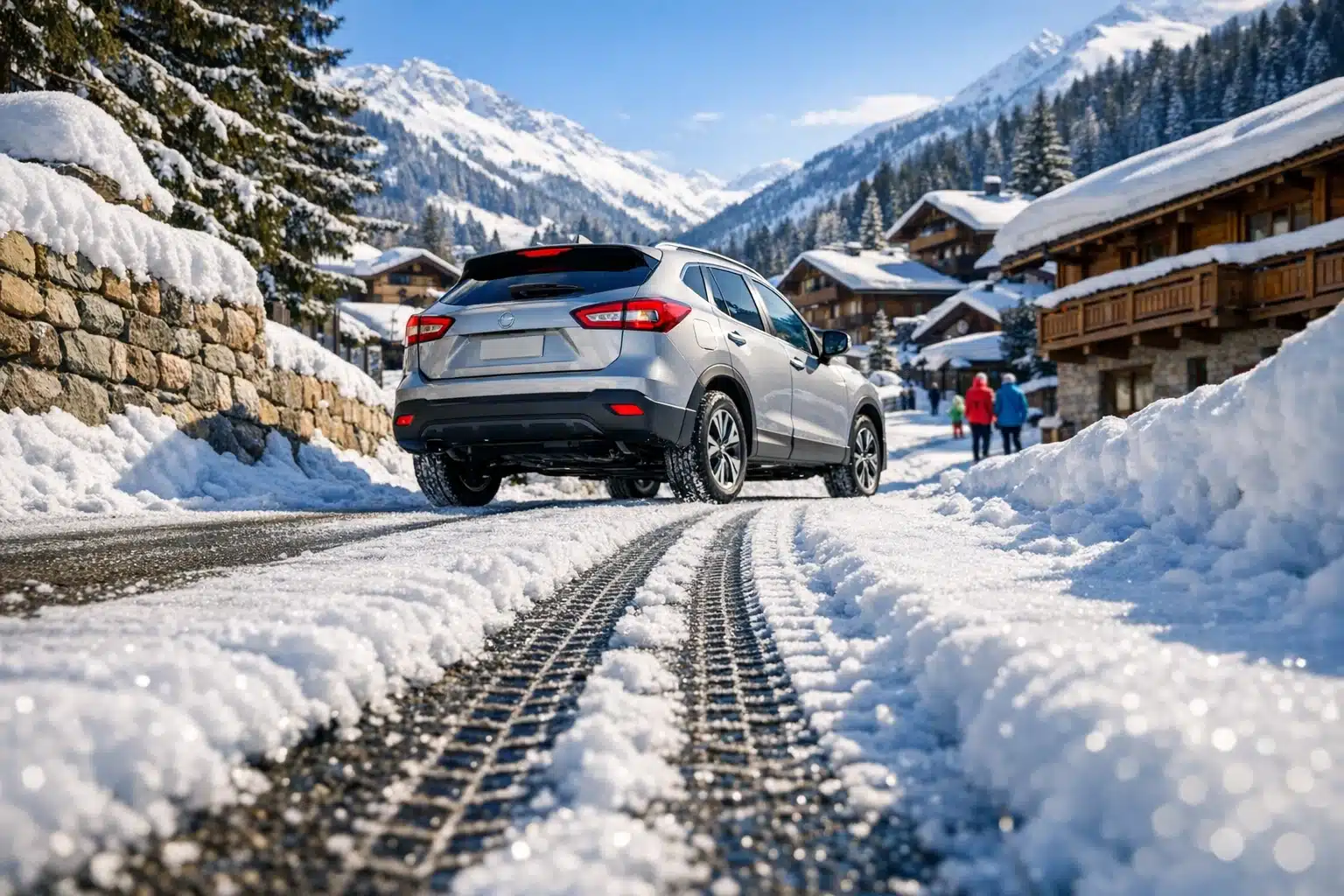
 Artificially generated image
 Benefits of Compact 4×4— Efficiency, maneuverability & rugged capability
Compact 4×4 vehicles sit in a sweet spot that many drivers overlook. They are small enough for crowded streets, yet capable enough to deal with muddy lanes, loose gravel, and winter roads that unsettle ordinary front-wheel-drive cars. As tighter parking spaces, higher running costs, and changing weather reshape the market, buyers want traction without the bulk of a full-size SUV. That is why modern crossovers, mini-SUVs, and lightweight off-roaders matter more than ever.
Outline
This article begins with the mechanics behind compact 4×4 systems and why small, lighter vehicles often feel more composed than their dimensions suggest. It then looks closely at mud, gravel, and snow, because each surface asks for a different response from the driveline, the tires, and the driver. The third part focuses on safe climbing, descending, and traction control features that help turn extra grip into genuine stability. After that, the guide compares crossovers, mini-SUVs, and lightweight off-roaders to show which kind of vehicle suits different lifestyles. The final section brings everything together with practical advice for readers who want confidence in rough conditions without giving up efficiency on ordinary roads.
How Compact 4×4 Systems Deliver Capability Without Excess
At first glance, a compact 4×4 can seem like a compromise: smaller than a traditional SUV, lighter than a truck-based off-roader, and often built on a passenger-car platform. In practice, that balance is exactly why this category works so well. Modern compact traction systems use electronic sensors, clutches, and software to react quickly when one axle or one wheel begins to lose grip. Instead of relying only on heavy mechanical hardware, many vehicles now combine on-demand all-wheel drive with brake-based traction control. The result is a setup that stays efficient in daily use and only sends extra torque where it is needed.
Most of these systems operate in front-wheel drive during steady cruising, especially on dry pavement, because that reduces fuel consumption and drivetrain drag. When wheel-speed sensors detect slip, a multi-plate clutch or electronically controlled coupling directs power to the rear axle. Some designs can also brake a spinning wheel so torque flows to the wheel with more grip on the same axle. That is not the same as a full locking differential found on a serious expedition vehicle, but for common low-traction situations it is remarkably effective.
The compact format brings several less obvious advantages:
- Lower mass means the vehicle has less momentum to manage on slippery ground.
- A shorter wheelbase can help with tight turns on narrow trails or in urban parking spaces.
- Smaller exterior dimensions improve visibility and make placement easier when roads get rutted or uneven.
- Car-based suspension usually gives a smoother ride on commuting routes and broken tarmac.
There are limits, of course. A compact drivetrain cannot create traction where tires, clearance, or underbody protection are missing. If the vehicle rides on road-biased tires and has modest ground clearance, the electronics may work hard but still struggle once deep mud, hard-packed snow ridges, or larger rocks enter the picture. Even so, for drivers who split their time between city streets, rural roads, and occasional rough weather, the blend is sensible. The best compact 4×4 systems are not built to conquer every landscape; they are designed to expand the range of places you can reach safely, efficiently, and with less stress than a two-wheel-drive alternative.
Mud, Gravel, and Snow: Three Surfaces, Three Very Different Challenges
People often group slippery surfaces together, but mud, gravel, and snow behave in distinct ways. A compact 4×4 that feels calm on a snowy road may still feel nervous on marbles of loose gravel, and a vehicle that pulls well through wet grass can bog down in deep clay. Understanding the surface is just as important as understanding the vehicle.
In mud, the main challenge is not merely slipperiness but resistance. Thick mud grabs at the tires, fills tread blocks, and increases rolling drag. A light vehicle has an advantage here because it sinks less readily than a heavier one, especially if tire pressures and tread design are appropriate. On-demand all-wheel drive helps keep the car moving when one end begins to slide, while traction control can tame wheelspin before the tires dig holes. Still, too much throttle is the classic mistake. Spinning faster rarely creates progress in mud; it usually creates ruts.
Gravel is different. It is a shifting layer of small stones over firmer ground, so the tires are looking for bite in something that wants to roll away from them. On gravel, stability matters as much as raw traction. A well-tuned compact 4×4 uses modest torque distribution and careful stability control to keep the vehicle tracking in the intended direction. Sudden steering, sharp braking, or aggressive acceleration can upset the balance more quickly than many drivers expect. Because the surface is loose, the car often communicates through small movements first. Paying attention early is wiser than waiting for a big slide.
Snow changes again depending on temperature and depth. Cold, dry snow can behave almost like sand, while wet snow is heavier and more adhesive. Ice beneath the snow is what catches people out. Four driven wheels help a vehicle get moving, but they do not rewrite the laws of braking. Winter tires matter enormously because rubber compound and siping influence grip more than drivetrain marketing ever will.
- Mud rewards momentum, restraint, and self-cleaning tread.
- Gravel rewards smooth inputs, straight-line braking, and careful steering.
- Snow rewards proper tires, gentle throttle, and extra stopping distance.
The real lesson is simple: a compact 4×4 is most effective when its mechanical ability, tire choice, and driving technique are working together. Remove one of those elements, and the whole system becomes less convincing.
Safe Climbing, Controlled Descending, and the Real Role of Traction Control
Climbing and descending are where confidence can either grow or evaporate. A vehicle that feels secure on a flat forest road may become awkward on a steep incline if the driver relies on power instead of judgment. Compact 4×4 systems can make hill work much easier, but they are aids, not substitutes for sound technique.
When climbing, momentum should be deliberate rather than dramatic. Too little speed and the vehicle may stall against the slope or lose traction as weight shifts rearward; too much and the driver arrives at obstacles with less time to react. Many compact vehicles perform best with a steady throttle and a transmission mode that avoids unnecessary upshifts. If the car has a selectable terrain program, hill mode, or low-speed off-road setting, it usually sharpens the coordination between engine response, braking logic, and torque distribution.
Before any climb, a quick mental checklist helps:
- Look at the surface ahead for ruts, stones, and sudden changes in camber.
- Choose the straightest sensible line to reduce side load and wheel lift.
- Leave enough space to stop safely if the route deteriorates.
- Avoid straddling obstacles that could strike the center of the underbody.
Descending demands even more patience. Gravity can accelerate a light vehicle quickly, and panic braking on gravel or snow may reduce control rather than restore it. Hill descent control, where fitted, uses the ABS hardware to manage each wheel and hold a low target speed. It can feel strange at first because the brake pedal may pulse and the system may sound busy, but on loose surfaces it often does a better job than a nervous right foot. In vehicles without that feature, low gear, gentle braking, and a straight approach are the classic tools.
Traction control deserves special attention because it is widely misunderstood. Some drivers think it only reduces power and gets in the way. In reality, modern systems are far more nuanced. They monitor wheel speed, steering angle, throttle position, and yaw behavior to judge whether the car is following the intended path. In a climb, traction control may brake a spinning wheel to redirect torque. On a descent, it may help keep individual wheels from locking as the surface changes beneath them. There are situations where partial deactivation is useful, such as deep snow or sand where a little wheelspin helps maintain momentum, but turning everything off without a reason is rarely a smart habit. Safe progress comes from smooth inputs, reading the terrain, and letting the electronics assist rather than dominate.
Crossovers, Mini-SUVs, and Lightweight Off-Roaders Compared
These three categories are often mentioned in one breath, yet they serve different purposes. A crossover is usually the most road-focused option. It tends to share its architecture with a hatchback or wagon, which means comfortable suspension tuning, quiet cruising, and efficient packaging. Many crossovers offer all-wheel drive mainly as a safety and all-weather feature rather than a serious trail tool. For buyers who spend most of their week on asphalt and only occasionally tackle muddy campsites, rough lanes, or snowy motorway exits, that is usually enough. The limitation appears when ground clearance, approach angle, or tire sidewall height becomes the deciding factor.
Mini-SUVs sit in an interesting middle ground. They often look rugged, but the better ones also add slightly more clearance, shorter overhangs, and software tuned for loose surfaces. That makes them more versatile than many people expect. They are still easy to park, easier to see out of than larger vehicles, and often cheaper to run than full-size SUVs. For rural households, mountain towns, or drivers who face patchy road maintenance, a well-chosen mini-SUV can be the practical sweet spot.
Lightweight off-roaders are the most specialized of the three. They are usually smaller, simpler, and more focused on geometry and low-speed control than on luxury. Some use proper four-wheel-drive systems with low range, locking differentials, or highly effective brake-based substitutes. Because they weigh less than large off-road vehicles, they can feel nimble on narrow tracks and more forgiving on soft surfaces. The trade-off is that they may be noisier, less refined at highway speeds, and less spacious for family use.
-
Choose a crossover if comfort, fuel economy, and urban driving matter most, but you still want winter confidence.
-
Choose a mini-SUV if you want extra clearance and a broader range of real-world ability without stepping into a bulky class.
-
Choose a lightweight off-roader if trail geometry, low-speed control, and durability rank above ride softness and cabin polish.
A useful comparison point is not the badge on the bonnet but the vehicle’s combination of tires, weight, clearance, wheel travel, and control software. Two cars with similar styling can behave very differently once the road turns slick or broken. That is why test drives on ordinary pavement never tell the whole story. A buyer should think less about image and more about where the vehicle will actually go in January, after rain, or at the far end of a gravel road with luggage on board.
Choosing the Right Compact 4×4 for Real Life
If you are shopping in this category, the smartest question is not “Which model looks toughest?” but “What kind of difficulty do I face most often?” A family in a snowy suburb needs something different from a photographer driving rutted farm tracks, and both need something different from a city resident who wants weekend freedom without suffering daily parking headaches. Capability only matters when it matches the job.
For that reason, tires should sit near the top of the checklist. A modest all-wheel-drive vehicle on excellent winter or all-terrain tires will often outperform a supposedly tougher machine riding on road-biased rubber. Ground clearance comes next, followed by underbody protection, hill-control features, and cargo practicality. Running costs matter too. Lighter vehicles generally consume less fuel, wear tires more slowly, and feel less cumbersome in town. Those traits may sound ordinary, yet they are exactly what make ownership sustainable beyond the excitement of the purchase.
One useful way to frame the segment is this: Explore compact 4×4 driving solutions — affordable, efficient systems designed for off‑road capability, urban maneuverability, and everyday reliabilit. Even with the unusual spelling in that phrase, the core idea lands well. People are not always searching for extreme adventure machines. Many simply want dependable traction, sensible dimensions, and the confidence to continue when weather or road quality turns mediocre.
Before making a decision, it helps to compare priorities in plain terms:
- Frequent snow and ice: prioritize winter tire support, stable electronics, and predictable steering.
- Regular gravel and broken lanes: prioritize suspension compliance, sidewall protection, and underbody clearance.
- Occasional muddy access roads: prioritize controllable torque delivery and tread that can clear itself.
- Mostly urban driving: prioritize visibility, parking ease, and low day-to-day operating costs.
For the target reader, the conclusion is reassuring. You do not need a giant SUV to gain meaningful extra traction, and you do not need a hardcore off-roader to travel safely beyond perfect pavement. The right compact 4×4, chosen with honesty about climate, terrain, and routine, can offer a rare blend of efficiency, maneuverability, and rugged usefulness. That blend is what makes this class so relevant now: it answers modern needs with tools that feel practical rather than theatrical.